
- May 2, 2026
- Freelancing
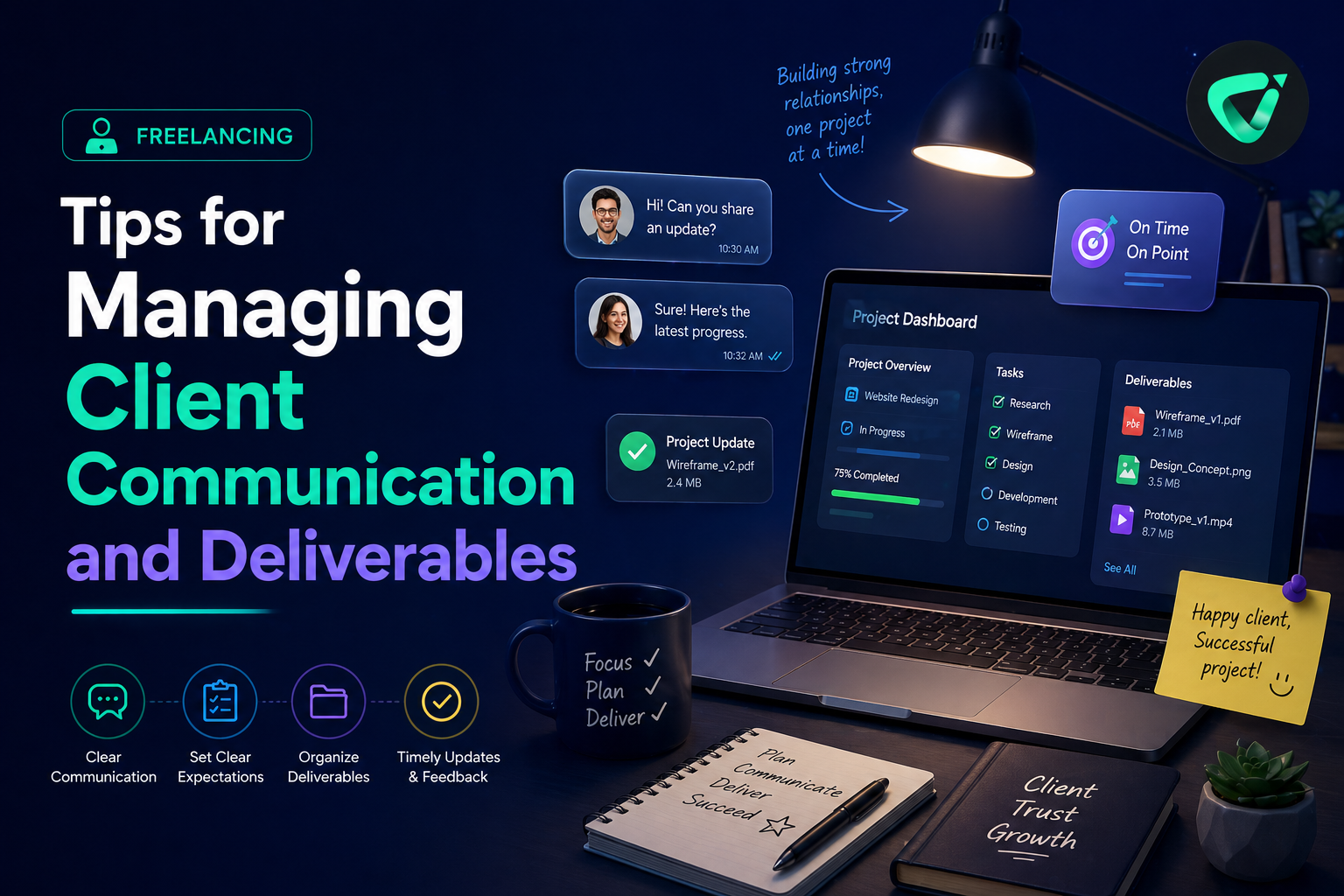
Tips for Managing Client Communication and Deliverables
Most freelance projects don't fall apart because of bad work. They fall apart because of a missed update, a misread brief, or a deliverable that landed differently than the client expected. Communication is the part of freelancing that nobody teaches you — and the part that quietly decides whether a client comes back or doesn't. Here's what actually helps.
1. Set expectations before the project starts
The best time to prevent a client problem is before the project begins. Most miscommunications don't start in the middle of a project — they were already there at the start, just not visible yet.
Before you take on any project, get specific about three things: what you're delivering, when you're delivering it, and what happens if either of those changes. That sounds obvious, but a lot of freelancers skip it because early conversations feel collaborative and informal, and introducing structure feels like you're being rigid.
You're not being rigid. You're making sure both sides are picturing the same outcome. A client who thinks "a website" means five pages with a contact form and a client who thinks it means a homepage only — those are two completely different projects, and the confusion will surface eventually. Better to surface it in the first conversation than three weeks in.
On Volnyn, every freelancer profile lets you define the scope of your services clearly before a client ever reaches out. Use that space. Specificity upfront saves time and back-and-forth later.
2. Get the brief in writing — every time
Verbal agreements feel fine in the moment. They're almost always a problem later.
Every project should have something written down — a brief, a proposal, a simple summary email — that both sides have seen and confirmed. It doesn't need to be a formal contract every time, though contracts help for larger work. Even a short email that says "here's what I understood from our call" and asks the client to confirm is enough to create a reference point.
The reason this matters isn't distrust. It's memory. Two weeks into a project, clients genuinely forget what they asked for at the start. So do freelancers. A written brief gives both sides something to point to when there's a disagreement about what was originally agreed.
Make it a habit. Write it up, send it, ask for a reply. It takes ten minutes and it's saved more projects than any other single habit on this list.
3. Agree on how you'll communicate
Different clients prefer different things. Some want everything in email. Some use Slack. Some prefer a quick call. Some will message you at 11pm and expect a reply by morning.
You don't have to accommodate all of that — but you do need to agree on a communication method at the start so nobody is guessing. Tell the client how you prefer to work. Ask how they prefer to receive updates. Settle on something you can both actually stick to.
Also worth setting early: your response time. If you reply to messages within 24 business hours, say that. If you don't check messages on weekends, say that too. Clients who know what to expect are far less anxious than clients who are just waiting and wondering.
Anxiety is usually what drives difficult client behavior. A client who sends four follow-up messages in a row isn't necessarily difficult — they might just not know what's happening with their project. Good communication habits fix that before it becomes a problem.
4. Update clients before they ask
The fastest way to look professional on any project is to send updates before the client has to ask for one.
You don't need daily check-ins. But a short update at meaningful points — when you start work, when you hit a milestone, when something takes longer than expected — goes a long way. It shows the client their project is on your radar. It also creates a natural record of progress that's useful if there's ever a question later about what was done and when.
Silence is the thing that makes clients nervous. A project that goes quiet for two weeks feels abandoned, even if a lot of work is happening. One message that says "I'm about halfway through, on track to deliver by Friday" takes two minutes to write and completely changes how the client experiences that two weeks.
This is one of the simplest habits in freelancing and one of the least practiced. The freelancers who do it consistently get more repeat work than those who don't — not because their actual work is better, but because the experience of working with them is better.
5. Structure your deliverables clearly
How you deliver work matters as much as the work itself, especially when the client isn't technical and can't immediately evaluate what they're looking at.
When you send a deliverable, don't just attach a file and say "here you go." Explain what's in it. Walk through the decisions you made and why. Point out anything that needs their input or approval. If there are multiple files, label them clearly so the client knows what to open first.
This does a few things. It gives the client context for reviewing your work, which means better and faster feedback. It also demonstrates that you understand what you were asked to do — which builds confidence even before they've fully reviewed the deliverable itself.
For longer projects, consider breaking deliverables into stages rather than handing everything over at once. Smaller checkpoints mean smaller corrections. Finding out a direction is wrong at stage one is manageable. Finding out at stage four is a problem for everyone.
6. Handle revision requests without losing the project
Revisions are part of the job. The way you handle them either strengthens the client relationship or quietly damages it.
The first thing to do when a revision request comes in is to understand it fully before responding. Ask questions if something is unclear. A client who says "this doesn't feel right" is telling you something — but not necessarily what needs to change. Get specific before you start reworking anything.
The second thing: be clear about what's included. Most projects include a set number of revision rounds. If a client's request falls within that, do it without complaint. If it goes beyond it — or if what they're asking for is a significant change to the original scope — that's a separate conversation, not just something you absorb silently and then resent later.
The way to have that conversation is direct but not defensive. Something like "this falls outside what we agreed for this round, but I can do it — here's what it would cost" is professional and fair. Most clients respect that. The ones who don't are telling you something useful about how the rest of the project will go.
7. Deal with scope creep early
Scope creep is what happens when small additions accumulate until the project is significantly larger than what was originally agreed — and you're doing extra work for the original price.
It rarely happens all at once. It's usually a "quick addition here," a "one small thing there," and a "while you're at it" that each seem reasonable individually. By the time the total adds up to something significant, it feels awkward to bring up because you've already been saying yes for weeks.
The fix is to catch it early and name it when it happens. You don't have to be aggressive about it. Something like "this is a bit outside the original scope — I'm happy to include it, just wanted to flag it so we can talk about whether to adjust the timeline or budget" is enough. That one sentence, said early, keeps the relationship clean.
Saying nothing and absorbing the work doesn't help either party. You end up underpaid and quietly frustrated. The client ends up with no idea that anything was off. Next time they hire someone they'll have the same expectations, and the next freelancer will have the same problem.
8. End projects properly
Most freelancers are good at starting projects. Fewer are good at ending them cleanly.
When a project wraps, don't just send the final files and disappear. Do a proper close. Confirm that all deliverables have been received and approved. Check whether there's anything outstanding. If the project involved files or access to client accounts, make sure everything is transferred and your own access is handed back or removed.
A short message — "everything's delivered, let me know if you need anything clarified or have any questions once you've had a chance to go through it" — is a small thing that leaves the client feeling looked after rather than dropped.
It's also worth asking for feedback, especially early in your freelancing career. Not every client will give it, but the ones who do usually have something useful to say. And a client who ends the project well is a client who might refer you to someone else, or come back when they have more work.
Repeat business and referrals account for a significant portion of income for most experienced freelancers. Those things don't happen by accident — they happen because the client's experience of working with you was good enough that they want to do it again.
Final Thoughts
Good client communication isn't a soft skill. It's a practical one, and it has a direct effect on your income, your reputation, and how much you enjoy the work.
The freelancers who build sustainable careers aren't always the most technically skilled people in their field. They're often just the most reliable to work with — the ones who set clear expectations, deliver what they said they would, and handle problems without drama when they come up. That combination is rarer than it should be, and clients notice it.
On Volnyn's freelancing marketplace, how you present yourself, communicate with clients, and deliver your work all contribute to how you're perceived on the platform — and how consistently work comes your way. The habits in this article aren't just good practice for any freelancer. They're what separates the ones who build something lasting from the ones who stay stuck chasing the next first client.
If you're not on Volnyn yet, create your profile at volnyn and start putting these into practice from your first project.