
- May 8, 2026
- Freelancing
Tips for Delivering Consistent Quality in Freelance Work
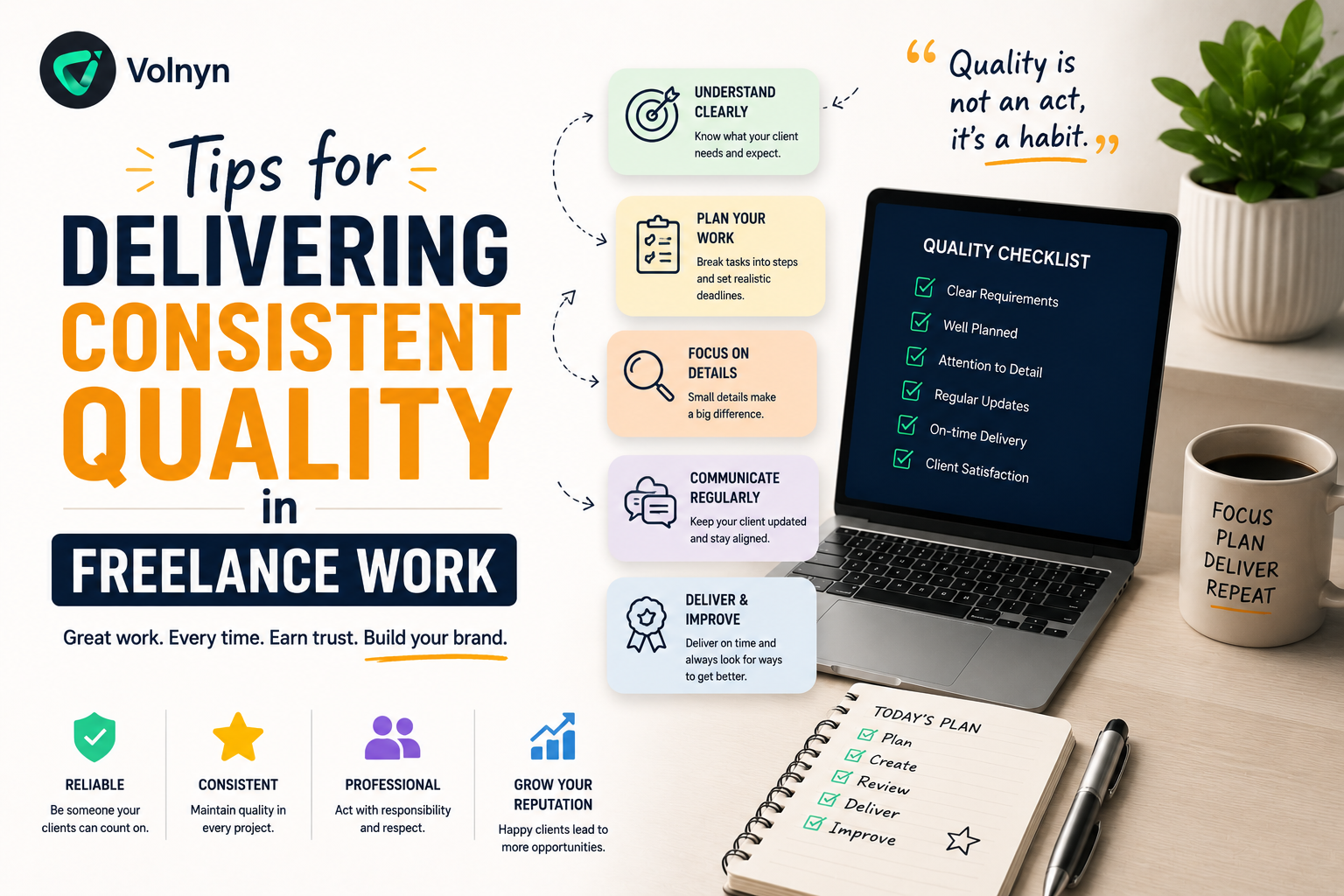
Getting a good result once isn't the hard part of freelancing. Getting a good result every time — across different clients, different briefs, different levels of available energy — that's where most people eventually run into problems. Consistency is what separates freelancers who build long-term reputations from those who stay dependent on finding new clients constantly. Here's what actually goes into it.
Why consistency is harder than quality
Most freelancers have produced work they're genuinely proud of at some point. The problem isn't capability — it's reliability. A client who receives excellent work on one project and average work on the next doesn't know which version of you they're going to get. That uncertainty is enough to make them look elsewhere, even if your best work is better than anyone else they've tried.
Consistent quality isn't the same as doing your best work every time. Your best work varies based on brief quality, available time, how well you slept, how interested you are in the subject. What consistency requires is a floor — a standard below which your work doesn't drop regardless of the circumstances.
That floor doesn't come from talent. It comes from having systems and habits that produce reliable results even on the days when motivation is low or the brief is unclear or the timeline is tighter than you'd like. That's what this article is about.
Build a process, not just a work style
A work style is how you naturally approach things. A process is a repeatable set of steps you follow regardless of how you feel on a given day. Both matter, but only one of them produces consistent results.
The specifics of your process depend on your field — a designer's process looks different from a writer's, which looks different from a developer's. But the structure is similar across all of them: understand the brief, plan before you execute, do the work, review it, then deliver. The freelancers who skip steps — usually the planning and review steps — are the ones whose output varies the most.
Write your process down, even roughly. When you start a new project, follow it. When you're tempted to skip a step because you're pressed for time, that's usually the moment the step matters most. A process you only follow when it's convenient isn't a process — it's a suggestion.
Set your own quality bar before the client sets one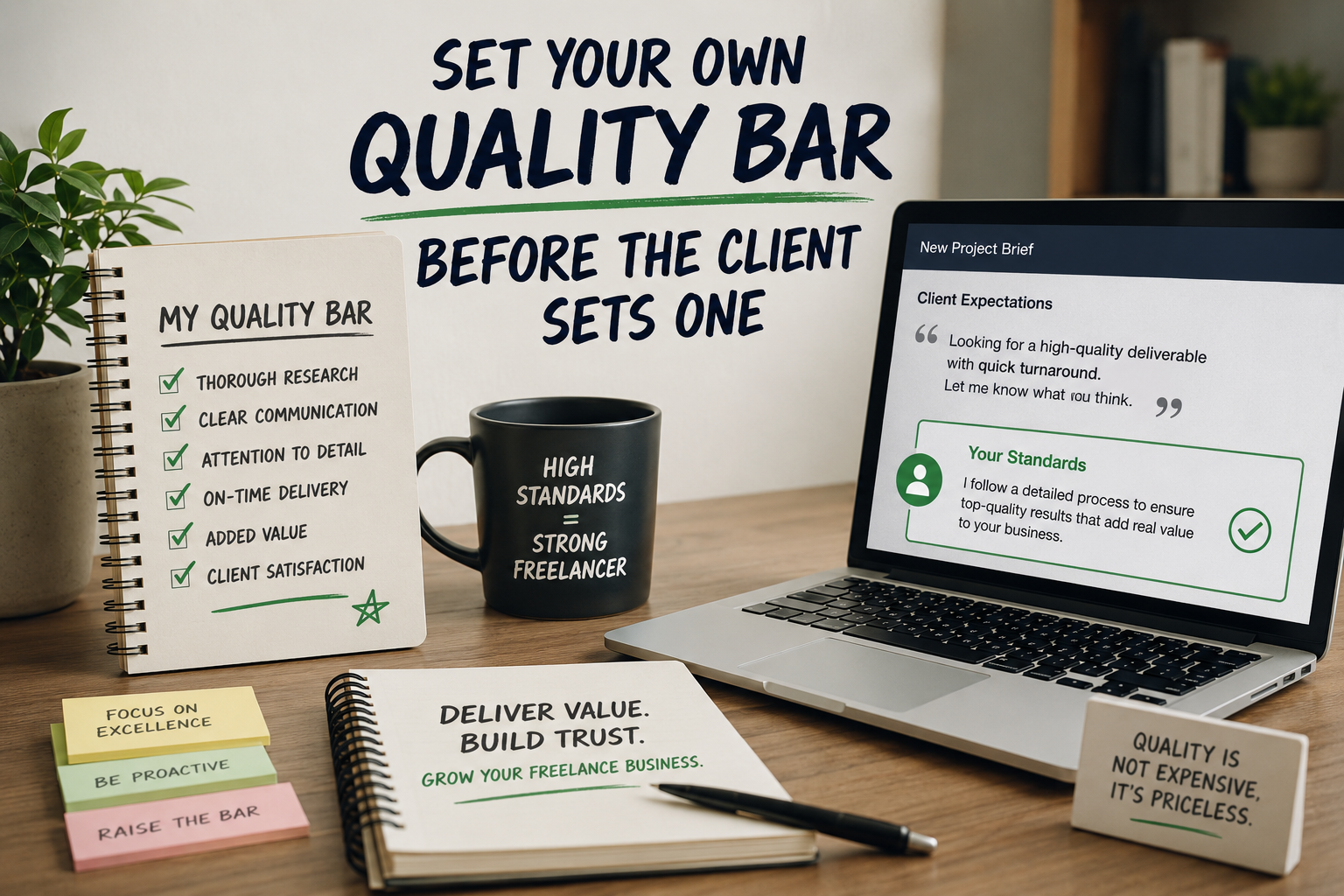
Clients set minimum requirements. Your own standards should be higher than that.
If you wait for client feedback to tell you whether your work is good enough, you're outsourcing your quality control to someone who may not know your field well enough to evaluate it properly. Some clients will accept work that's below your actual capability and never say anything. That's not a win — it's a slow erosion of your standards.
Know what good looks like in your work, specifically. Not "professional" or "high quality" in the abstract — concrete things you can actually check. For a writer, that might mean: does every sentence serve a purpose, is the structure logical, does the opening paragraph earn the reader's attention? For a designer: does the layout breathe, is the hierarchy clear at a glance, does it work on mobile? Define it, and use it as your checkpoint before anything goes out.
Manage your energy, not just your time
Time management is what most freelancing advice covers. Energy management is what actually affects output quality.
You can have four hours blocked out for a project and produce poor work if you're in the wrong headspace for it. You can have ninety minutes and produce your best work if you're focused and the conditions are right. The variable isn't always time — it's the quality of the attention you bring to the work.
Figure out when your thinking is sharpest. Most people have a few hours in the day when they do their best work, and the rest of the day is better suited to administrative tasks, communication, and less demanding work. Do the work that requires real quality during your peak hours. Don't schedule your most important deliverables for the end of a day when you've already used most of your concentration on other things.
This sounds basic, but most freelancers don't structure their day around it. They work whenever there's time rather than being deliberate about when different types of work happen. The result is inconsistent output that reflects when something was done as much as how much effort went into it.
Handle unclear briefs before they become bad outcomes
A lot of inconsistent output comes from inconsistent input. If a brief is vague, your interpretation of it might be different from what the client had in mind — and you won't find that out until you've already done the work.
Ask questions before you start. Not ten questions that make the client feel like you're stalling, but the two or three that resolve genuine ambiguity about what the outcome should look like. What's the intended audience? What does success look like for this piece? Is there anything it definitely shouldn't do or say?
The freelancers who consistently deliver work that lands well aren't just more talented — they're better at extracting the right information upfront. A ten-minute conversation before starting a project saves hours of revision afterward and produces work that's more likely to hit the mark on the first pass.
Review your own work before sending it
This one seems obvious and is consistently skipped.
Before any deliverable goes to a client, look at it as if you're the client seeing it for the first time. Not as the person who made it, who knows what every decision was and why — as someone encountering it cold. Does it make sense? Does it answer what was asked? Are there obvious problems you'd be embarrassed to have pointed out to you?
A simple habit: finish the work, step away for at least thirty minutes, then review it. The distance changes what you see. Errors and weak sections that were invisible when you were in the middle of creating become obvious once you've been away from them. Many of the revision requests freelancers receive are for things they would have caught themselves with a proper review.
Build the review into your process and timeline. If your deadline doesn't allow for a review step, your deadline is too tight — either push back on it or factor review time into your estimate from the start.
Learn from the work that didn't land
Every freelancer has projects that didn't go well. A client who was hard to satisfy, a deliverable that needed more revisions than expected, work that got rejected or substantially changed. These are not just bad experiences to move past — they're information.
When a project ends badly or requires significantly more revision than usual, spend ten minutes afterward asking what actually went wrong. Was it a brief that wasn't clear enough? A process step that got skipped? Work done too quickly? A mismatch between what the client wanted and what you understood them to want?
The answer is usually one of a small number of things. Identifying which one is the difference between making the same mistake again and actually improving. Freelancers who improve steadily over time aren't just more experienced — they're more deliberate about extracting lessons from the work that didn't land, rather than just moving on and hoping the next project goes better.
How consistency builds your reputation on Volnyn
On Volnyn's freelancing marketplace, how you're perceived as a freelancer is built over time through your work and how clients experience working with you. Consistent quality is the thing that drives repeat work and referrals — which, for most experienced freelancers, becomes the primary source of new projects rather than constantly acquiring new clients from scratch.
A client who receives reliable, high-quality work doesn't need much convincing to come back. They've already removed the uncertainty that makes hiring a freelancer feel like a risk. That trust is hard to build and easy to lose — one project that drops significantly below your usual standard can undo the confidence built by several good ones.
The habits in this article — a repeatable process, clear quality standards, proper review before delivery — are what protect that trust. They're also what let you take on more work without your quality dropping as your volume increases, which is the next challenge most freelancers face once consistency is in place.
If you're not yet on Volnyn, create your profile at volnyn.com and start applying these habits from your first project on the platform.
Final Thoughts
Consistency in freelance work is a habit problem more than a talent problem. The freelancers who deliver reliably aren't always the most skilled people in their field — they're the ones who've built systems that produce good results regardless of the day, the client, or the brief.
That's learnable. It requires being honest about where your process breaks down, building in the steps that prevent the most common failures, and holding yourself to a standard before the client has to. None of it is complicated. Most of it just requires doing it deliberately rather than assuming good intentions will be enough.
Good intentions produce good work sometimes. A solid process produces it consistently. The second one is what builds a freelance career that lasts.
Frequently Asked Questions
1. How do I maintain quality when I'm handling multiple projects at the same time?
The key is not letting projects overlap in a way that means you're doing demanding work on all of them simultaneously. Stagger deliverables where possible, protect your peak working hours for the project that needs the most attention, and treat each project's review step as non-negotiable regardless of how busy you are. Quality drops when the review step gets skipped under time pressure — that's usually when the problems appear.
2. What should I do when a client's brief is genuinely too vague to work from?
Ask for clarification before you start, not after you've delivered something that missed the mark. Keep your questions specific — ask about the intended audience, the desired outcome, and anything that would tell you what success looks like for this piece. Two or three targeted questions resolve most ambiguity. If a client can't or won't answer those questions, that's useful information about how the project is likely to go.
3. How do I handle a situation where my work genuinely didn't meet the client's expectations?
Own it without overexplaining. Ask what specifically didn't work and what they'd need to see in a revision. Then fix it properly — don't make surface-level changes that address the symptom without solving the actual problem. Afterward, spend time figuring out where the disconnect came from so you can prevent the same thing happening on the next project. Clients generally respond well to a freelancer who handles problems directly rather than defensively.
4. Is it worth turning down work that I don't have the capacity to do well?
Yes. Taking on work you can't deliver to your usual standard is a short-term income decision with long-term reputation costs. One project that goes badly can undo several that went well in terms of how a client perceives you. If your current workload means you can't give a new project proper attention, it's better to say so honestly — most clients respect that more than they respect someone who takes the project and delivers something below par.
5. How long does it take to build a reputation for consistent quality as a freelancer?
There's no fixed timeline — it depends on how much work you're doing and how deliberately you're applying good habits. What moves it faster is repeat clients, because each repeat engagement is evidence that someone trusted your work enough to come back. On a platform like Volnyn, where your profile reflects your track record, consistent quality compounds over time in a way that makes acquiring new clients progressively easier.