
- June 5, 2026
- Website Builder
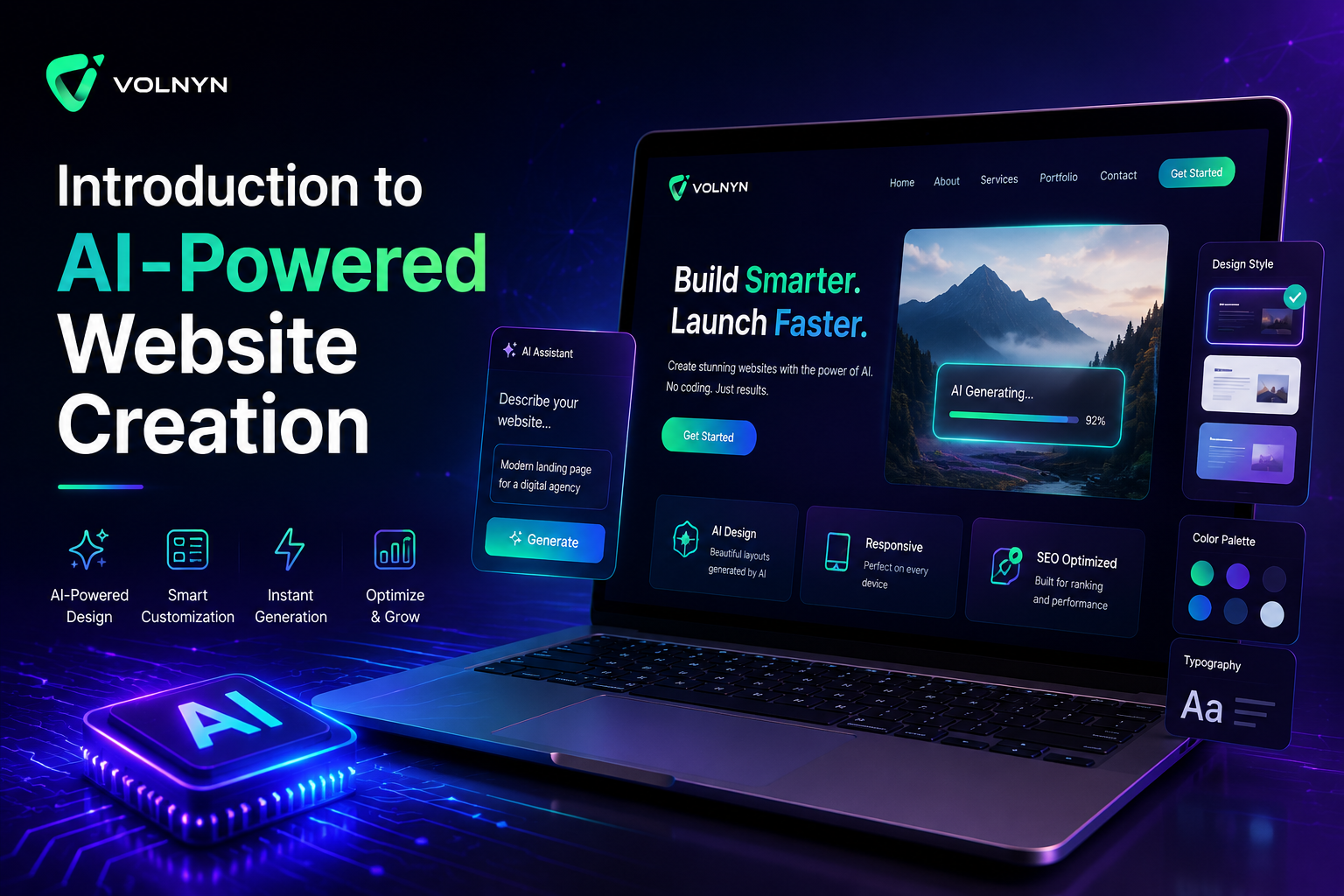
Introduction to AI-Powered Website Creation
Introduction
Building a website has always been a mix of technical, design, content development, and maintenance skills. For many, it meant finding developers to work on their site, mastering complicated software, or dedicating lots of time to the upkeep of their site. However, in recent years, artificial intelligence has started to change the way websites are planned, designed, and launched.
The use of AI in website building is a significant transformation in digital evolution. This is not done by starting from scratch and adding every single page individually; users can now take advantage of intelligent systems that can guide their design decisions, organize content, generate layouts, and even customize them. This way of doing it can not only make website creation easier, but also help make websites more accessible to the masses.
With the rapid advancements in AI technology, the platforms that web builders use are increasingly incorporating these features, revolutionizing the way businesses, freelancers, creators, and organizations create their online presence. By grasping the functionality of AI-driven website generation, users can better navigate the realm of contemporary web development tools and processes.
Table of Contents
- Understanding AI-Powered Website Creation
- How AI Website Builders Work
- Key Technologies Behind AI Website Development
- The Website Creation Process with AI
- Benefits of AI-Powered Website Creation
- Challenges and Limitations to Consider
- Common Use Cases Across Industries
- Best Practices for Using AI in Website Development
- The Role of Human Input in AI Website Creation
- Emerging Trends in AI-Powered Web Design
- Final Thoughts
- Frequently Asked Questions
Understanding AI-Powered Website Creation
AI website creation involves leveraging artificial intelligence tools to help create, organize, and develop websites. AI systems analyze user needs and offer suggestions or even design websites, eliminating the need for manual coding of each page element.
This usually starts with a set of questions concerning the desired goals, industry, business type, target audience, and design preference of the user. Using this data, the AI system creates layouts, navigation, content sections, colour schemes, and more for websites.
In contrast to conventional website building, which involves numerous repetitive and laborious tasks that need to be performed by hand, AI can help carry out many of these tasks automatically. This enables users to consider more business goals and content planning, and less technical implementation.
The rise of AI website builders is part of a larger trend to streamline digital tools and make them more accessible for non-technical users.
How AI Website Builders Work
AI website builders work through the use of machine learning algorithms, design structures, and user content to create websites quickly and effectively.
Typically, the process begins with user input. The site collects details of the purpose of the site, whether it be a business, a portfolio, an online store, a service, a property listing, or something else.
After gathering this data, the AI system reviews similar design patterns and standards in the industry. It then creates a suggested website structure consisting of:
Layout Recommendations
The AI is responsible for structuring the pages and presenting the information to the visitors. This encompasses homepage designs, service pages, contact sections, as well as navigation menus.
Design Suggestions
Depending on the website's target users and industry, the AI can suggest typography, colour schemes, spacing, and visual features that are suitable for the contemporary times in which they are being created.
Content Organization
AI tools can help organize information logically, ensuring visitors can easily navigate the website and find relevant information.
Responsive Design Adaptation
Contemporary AI website builders usually create designs that work on any desktop computer, tablet, or mobile device, and do not require a separate development effort.
These principles are applied to website building platforms like Volnyn's AI Website Builder, which make it easier to create a website while still offering the flexibility to create them exactly how the user desires.
Key Technologies Behind AI Website Development
There are a number of technologies that enable AI-driven website development.
Machine Learning
AI systems can identify patterns in vast amounts of data related to website design, user behavior, and industry practices using machine learning. The recommendations generated based on these insights provide a basis for recommendations consistent with the principles of good design.
Natural Language Processing
Natural language processing, also known as NLP, enables users to communicate website requirements with natural language. Users do not need to set up dozens of technical parameters; they can explain what they want to do and the AI can understand it.
Predictive Design Systems
Predictive design technology is a tool that can use patterns and user engagement data to predict what type of layout, navigation, and content arrangement will perform well.
Automated Content Assistance
Certain AI systems help in initial content creation, page description generation, heading creation, and information organization to enhance readability and user experience.
These technologies, when combined, streamline complexity and increase efficiency in the process of creating a website.
The Website Creation Process with AI
Most AI website builders will have a similar process, although workflows may differ in certain aspects.
Step 1: Define Objectives
Users state the purpose and target audience of the website. This data is used to help tailor AI recommendations.
Step 2: Generate the Initial Website
The AI generates a basic structure for the website, which may feature several pages, menus, content sections, and visual components.
Step 3: Review and Customize
Users check the design created and make changes to branding, content, pictures, format, and function.
Step 4: Fill in Content for the Business
Services and products, team members, contact information, pricing, and other relevant content can be added.
Step 5: Publish and Maintain
The website can be published and updated as time goes on. After launching, many AI-powered systems keep offering ideas to optimise and enhance their performance.
This workflow will greatly cut back the time needed to get from idea to finished site.
Benefits of AI-Powered Website Creation
There are a number of practical benefits driving the rise of AI website builders.
Faster Development Timelines
Traditional website building projects can take weeks or months, contingent upon the level of complexity. Many of the initial setup tasks can be automated using AI-assisted workflows, which can significantly cut down initial setup time.
Improved Accessibility
Not all business owners or professionals have the capabilities to develop a website. AI-driven tools can help fill the gap by streamlining technical tasks.
Reduced Barriers to Entry
There is no need for a lot of technical expertise or big budgets to create an online presence for an individual or a small group of individuals.
Consistency in Design
AI systems can also be used to ensure that the website maintains a consistent visual style, which can help create a more cohesive and visually appealing experience.
Scalability
AI-powered tools can aid in the process of updating, adding content, and making structural adjustments as businesses expand.
Enhanced Productivity
Teams will be able to focus more resources on other strategic activities like marketing, customer engagement, and business development because repetitive tasks are automated.
Challenges and Limitations to Consider
While there are significant benefits to AI-driven website building, it also has its drawbacks.
A Lack of Creativity in Some Situations
Existing design patterns and data are typically used to power AI systems. This is a great method to create websites that work, but if the website is very different or unusual in design, a lot of human touch may be needed.
Content Accuracy Concerns
If content is created using AI, users need to review the information created to ensure it is accurate, clear, and appropriate for organisation objectives.
Custom Development Requirements
For businesses that have specific technical needs, there might be a need for custom coding and specialized development skills.
Brand Differentiation
Organizations need to make sure that their website does not only follow automated recommendations, but also reflects their own identity, tone, and purpose.
Ongoing Human Oversight
AI should not be considered a replacement for human decision making, but as an assistant to it. At the heart of everything strategic, branding, and understanding the customer will always be tasks for humans.
When using AI tools for website building, it is important to have realistic expectations based on their limitations.
Common Use Cases Across Industries
AI website builders are used in various industries.
Small Businesses
AI website builders are also leveraged by local businesses to quickly create websites that look professional, thereby connecting with their online presence.
Freelancers and Consultants
With minimal technical investment, independent professionals can develop a portfolio website, a service page, and a platform for client acquisition.
Real Estate Professionals
AI-driven layouts for property listing websites can help to effectively structure property information, images, and contact details.
E-Commerce Businesses
AI can be used to create product pages, navigation menus, and customer-centric designs for online stores.
Educational Organizations
AI tools are now widely adopted in the creation of informative websites for schools, training providers, and other educational institutions, enhancing efficiency.
Digital Service Platforms
AI website creation use cases can also support marketplaces and digital platforms, including freelancing, gaming, and property-related services, where scalable digital experiences are important.
Best Practices for Using AI in Website Development
To make the most of AI website building, best practices need to be observed.
Begin with Clear Goals
Understand and establish the website's goals first to avoid getting lost in the nuances of AI. The outputs may be of a poor quality if the inputs are of poor quality.
Customize Generated Designs
Do not publish without reviewing AI-generated websites. Personalization enables the final product to be tailored to the brand and business objectives.
Prioritize User Experience
Pay attention to the design of the navigation, readability, accessibility, and usability, not just the looks.
Maintain Content Quality
Make sure that the content is accurate, informative, and meets audience expectations.
Monitor Performance
Monitor website analytics, user interactions, and engagement trends frequently to spot areas for improvement.
Maintain Human Oversight Involvement
Human expertise continues to lead strategic decisions, messaging, branding, and customer communication.
The Role of Human Input in AI Website Creation
One common misconception is that AI completely eliminates the need for human involvement. In fact, there is still a lot of the human element that is involved in successful websites.
Businesses know their customers better than any algorithm, and they know their industry problems, competitive landscape, and organization goals better than anyone else. AI can help with execution, but manual input is crucial for context and direction.
The decisions that are made for content, visual identity, customer messaging, and strategic positioning on the website should be thoughtfully made. While AI can speed up these processes, it is important to note that there are still elements of creativity and experience that need to be added to achieve meaningful differentiation.
The best solution is to use AI to be efficient but still rely on human judgement. AI is not intended to replace website developers, but to assist them in achieving improved results and enhance their productivity.
Emerging Trends in AI-Powered Web Design
AI for website building is expected to become even more sophisticated in the future.
Website experiences can be personalized dynamically depending on the user's actions and preferences.
Enhanced conversational interfaces may enable the creation of websites entirely with natural language directions.
There is a potential for further automation of development workflows with AI-generated visual assets, enhanced accessibility suggestions, and optimization systems.
Integration of webpage builders and other digital services will increase as well. For instance, a business can start to integrate website platforms with marketplaces, customer management systems, property listings, content management systems, and so on.
As these technologies continue to evolve, the use of AI to create websites is likely to be integrated into the broader field of digital development, rather than being a niche use case.
Final Thoughts
The development of AI-powered website creation is a significant advancement in the design and creation of websites. AI streamlines and automates numerous technical and repetitive tasks, making professional web development more accessible to businesses, entrepreneurs, freelancers, and entities of all sizes.
But even the best sites rely on goals, good content, strategic choices, and constant human involvement. While AI is a mighty tool that can advance the development process and boost efficiency, it is most effective when used in tandem with human skills and insight.
In a rapidly evolving digital landscape, AI-driven website building will increasingly become crucial in assisting organizations in creating and sustaining their online footprint.
Frequently Asked Questions
What is an AI-powered website builder?
An AI-powered website builder is a platform that utilizes artificial intelligence to help its users build websites. Users enter their information on what they want to achieve, the nature of their business, and their preferences, and the AI creates structures, design recommendations, and content organization suggestions for their website. These are the tools that can make website development easy for those who are not so experienced in programming, but still want to make a website. While AI can handle many tasks, users generally have the final say on customization and final publication.
Can AI completely replace web developers?
While AI can streamline many parts of the website development process, it is not a replacement for web developers. Very specific user experiences, complex applications, custom integrations, and advanced functionality may exceed the capabilities of AI today. Developers also provide strategic problem solving, performance optimization, security planning, and custom development. AI should be considered a productivity tool that helps developers and non-technical users, not a replacement for professional web development services.
Is it viable for small businesses to create websites with AI?
For small businesses, AI-powered website creation can be especially beneficial in minimizing the hurdles of building and maintaining a professional website. Compared to more traditional methods of website development, small business owners may be able to build a functional website in a shorter period of time, and with less technical issues. AI can help with layouts, design suggestions, and content structuring, enabling businesses to concentrate on their operations and customer interaction. Businesses should still spend time to check text, the branding, and to make sure that the website is a reflection of their identity.
In what ways can AI enhance website design?
The process of analysis of the principles of web design, user behavior patterns, and industry standards is enhanced by AI. It can suggest layouts, navigation, colour schemes, typography, and content structures to enhance usability and accessibility. AI can also ensure that your website has a consistent layout and detect design features that could improve user engagement. These suggestions are a good foundation, but human input is necessary to make sure the final design meets the objectives of the business and the expectations of its audience.
Do AI websites deliver mobile optimization?
The majority of AI website builders create a responsive website which automatically adjusts itself to various screen sizes. This can allow websites to be developed to work on both desktop computers, tablets, and smartphones without having to make a special effort for each platform. With so many people using mobile devices for the Internet, mobile responsiveness is an important factor for any website performance. While AI can help with responsive design implementation, it is crucial for website owners to test their sites on various devices to ensure a uniform user experience.
Which industries are most likely to be helped by AI website builders?
While AI-driven website creation can be useful for virtually any industry, it is especially advantageous for small businesses, professional service providers, freelancers, consultants, real-estate professionals, educational institutions, and e-commerce companies. For industries which need a lot of updates in the website or quick deployment, they get huge efficiency boost. For instance, AI can help streamline development processes and ensure that property listing sites, service marketplaces, or content-rich websites stay well-designed and easy to use without compromising on quality.
What are the potential impacts of AI on website development?
In the future, AI is likely to further improve its capabilities in website development, with more sophisticated automation features, personalization, and content creation. Going forward, systems can make increasingly complex design suggestions, optimize in real-time, provide accessibility enhancements, and anticipate how users interact with the space and analyze that user feedback to adapt in real-time. Also, natural language website creation, intelligent content management, and more intelligent integration with business tools are expected to become more widespread. As AI continues to develop, it will still be vital to human expertise, but it will continue to assist organizations in their efficient creation and management of websites.